Interactive Brokers Trader API
Research account, portfolio, market-data, session, and order-management questions for an Interactive Brokers integration.
Independent overview →Trader API and Ai Trader LLM API research for brokerage, cryptocurrency, futures, forex, charting, market-data, and prediction-market developers.
Independent informational resource. Not a broker, exchange, adviser, or provider of a live trading API.
Independent developer resource
TraderAPI.com organizes the technical questions behind a modern Trader API: what data is available, how instruments are identified, which timestamps and units are authoritative, how a stream recovers, how orders transition through state, and how credentials are constrained.
The site covers brokerage APIs, cryptocurrency exchange APIs, futures and forex interfaces, charting systems, prediction markets, and Ai Trader LLM API architectures. It does not provide a universal ranking because the right choice depends on the application workflow, account, region, data rights, asset class, and risk controls.
Use the directory to create a shortlist, then collect evidence from current official documentation, terms, support responses, sandboxes, and controlled tests. Mark unknown behavior as unknown. In trading infrastructure, an undocumented assumption can become a data error, duplicate order, or unreconciled position.
Major platform research
These pages are independent evaluation frameworks. References to company and platform names do not imply sponsorship, endorsement, partnership, or affiliation.
Research account, portfolio, market-data, session, and order-management questions for an Interactive Brokers integration.
Independent overview →Evaluate strategy, add-on, futures-data, order-event, testing, and deployment responsibilities associated with NinjaTrader workflows.
Independent overview →Organize due diligence for products, regional access, symbols, filters, streams, signing, order books, and operational recovery.
Independent overview →Review market-data, account, portfolio, order, credential, streaming, and reconciliation requirements for Coinbase-related interfaces.
Independent overview →Map events, questions, outcomes, rules, market states, order books, prices, and settlement information without treating price as certainty.
Independent overview →Evaluate series, events, contracts, price units, rules, authentication, orders, fills, lifecycle states, and eligibility.
Independent overview →Trader API categories
Each category presents a different data model, operational boundary, and failure surface. Choose the page that matches the system you are actually building.
Account data, positions, permissions, market data, orders, fills, paper testing, and reconciliation.
Explore broker APIs →Exchange products, symbols, order books, public streams, authenticated state, signing, and exact numeric rules.
Explore crypto APIs →Events, outcomes, contract rules, price interpretation, market lifecycle, orders, and settlement.
Explore prediction APIs →Intraday quotes, scanners, alerts, watchlists, charts, order tickets, positions, and loss controls.
Explore day-trading APIs →Specific contracts, months, expiry, tick value, sessions, continuous series, margin, and order state.
Explore futures APIs →Currency-pair identity, bid and ask, pips, units, session context, conversions, positions, and leverage risk.
Explore forex APIs →Candlesticks, source semantics, real-time bars, indicators, annotations, accessibility, and data recovery.
Explore charting APIs →Trusted evidence, bounded tools, deterministic risk, human approval, idempotent routing, and audit logs.
Explore AI architecture →Ai Trader LLM API
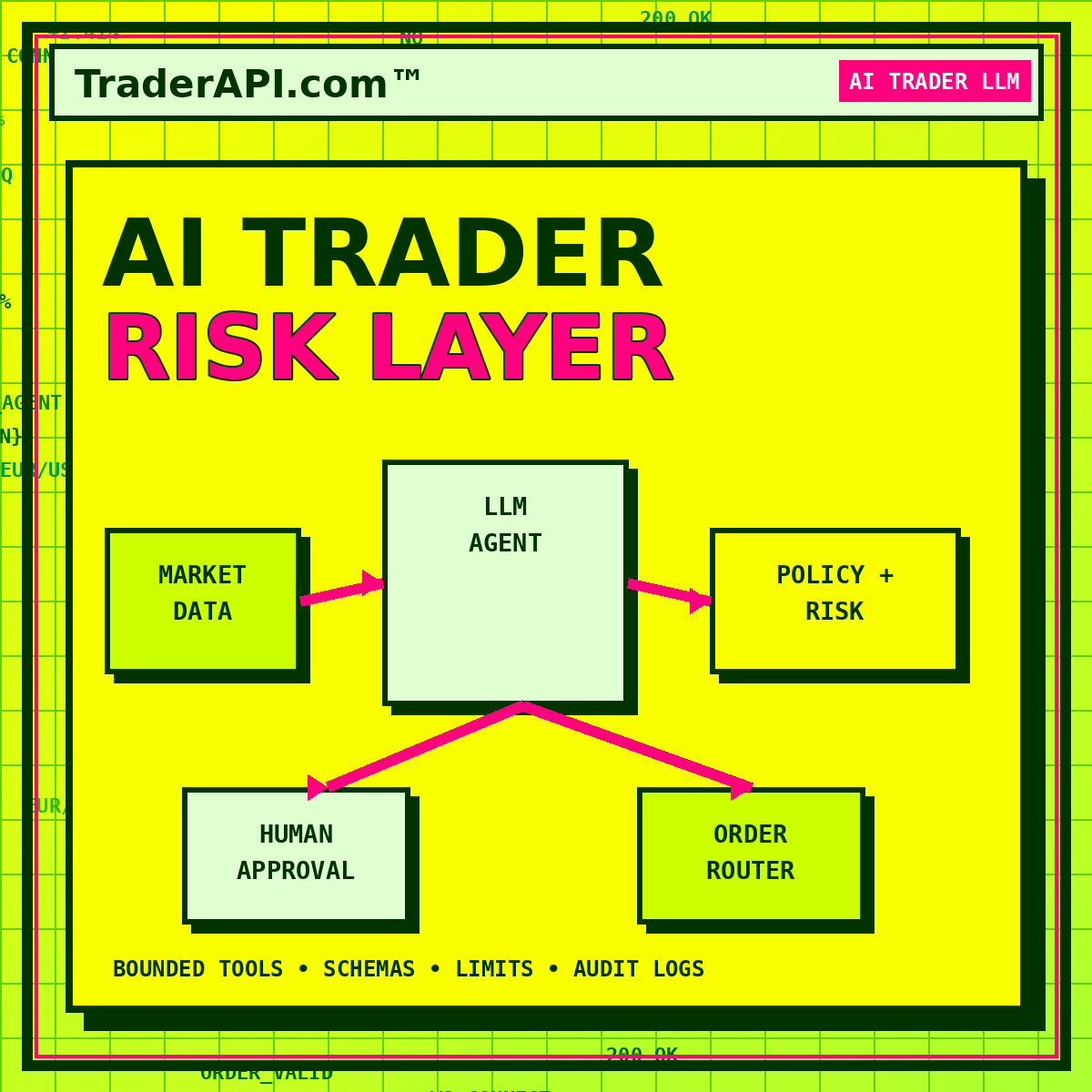
An AI trading assistant can retrieve research, explain market data, summarize portfolio context, or draft a structured proposal. It should not receive a raw brokerage credential or invent an order from unrestricted natural language.
A safer design uses typed tools and a deterministic policy layer. The model proposes; code validates current prices, account state, permissions, position limits, order increments, and approval requirements. A restricted router owns the execution credential and reconciles the final provider state.
Comparison framework
A feature name is a starting point. Production readiness depends on precise behavior, constraints, and recovery.
| Area | Questions | Evidence | Failure test |
|---|---|---|---|
| Instruments | Identifiers, venues, increments, status, reference data? | Schema + sample universe | Expired or unavailable symbol |
| Market data | Quote type, timestamps, depth, bars, corrections, delay? | Docs + captured stream | Gap, reconnect, late correction |
| Authentication | Scopes, expiry, signing, IP rules, revocation? | Credential settings + logs | Expired or revoked credential |
| Orders | Types, lifecycle, client IDs, replace/cancel, fills? | Sandbox + state log | Timeout after submission |
| Operations | Limits, maintenance, status, support, backfill? | Load test + incident plan | Throttle and degraded stream |
| Rights and cost | Display, storage, redistribution, subscriptions, fees? | Terms + cost model | Peak-volume scenario |
Conceptual API example
This demonstration endpoint is illustrative only. It shows how an internal application gateway can provide consistent schemas while provider adapters preserve raw identifiers and errors for reconciliation.
A gateway can centralize authentication, authorization, rate limiting, data freshness, logging, and policy checks. It should not hide meaningful market differences or convert an uncertain provider response into a false success.
const response = await fetch(
  "https://api.traderapi.com/v1/markets",
  { headers: { "Accept": "application/json" } }
);

if (!response.ok) throw new Error("Request failed");
const market = await response.json();

// Demonstration only. No public API is claimed.
console.log(market.dataFreshness, market.source);
2026 field notes
Long-form engineering articles on API comparison, AI risk architecture, credential security, prediction-market models, and futures or forex data.
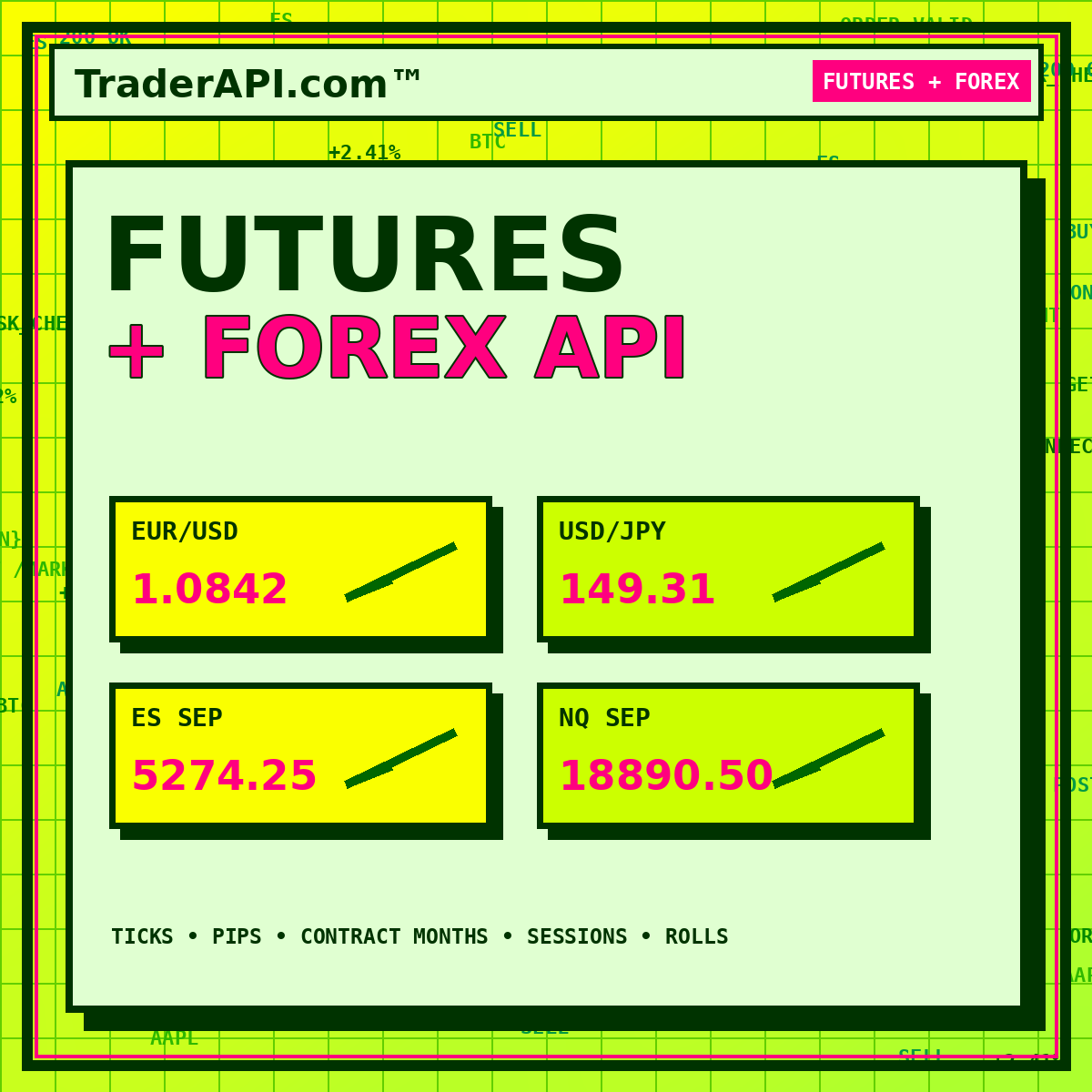
Build futures and forex API integrations with explicit symbols, contract rolls, tick and pip values, sessions, timezones, bid/ask data, and position units.
Read 12-minute guide →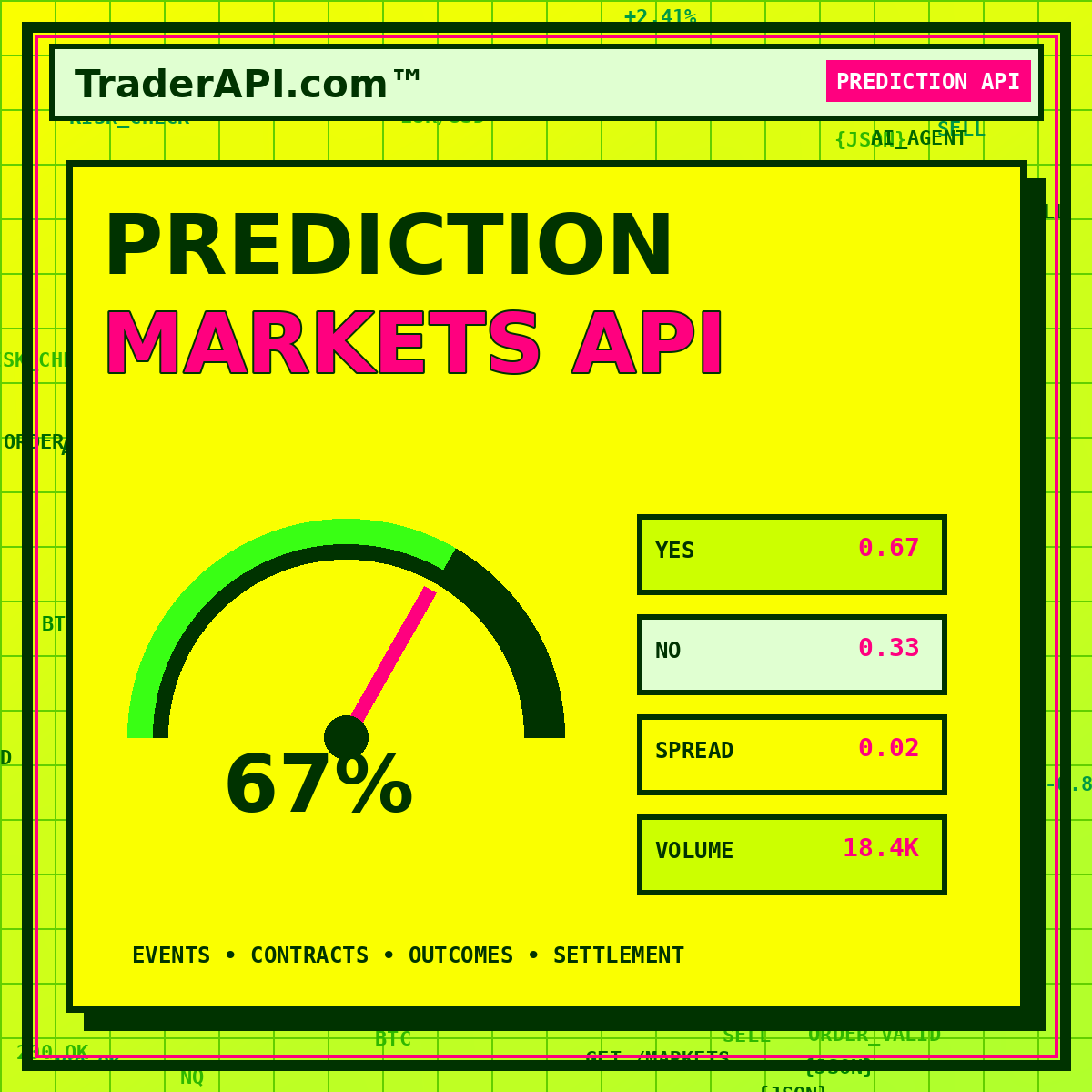
Understand prediction-market API concepts including events, markets, outcomes, prices, order books, settlement states, streaming, and historical data.
Read 12-minute guide →
Protect brokerage API keys with server-side storage, least privilege, rotation, signing controls, audit logs, front-end isolation, and incident playbooks.
Read 11-minute guide →Trader API FAQ
Concise answers to the terms, controls, and responsibilities used throughout TraderAPI.com.
A Trader API is a software interface for market data, account information, portfolio state, charting, order management, or related trading workflows. Each provider defines its own products, permissions, schemas, and operating rules.
An Ai Trader LLM API connects a language model to trusted market or portfolio data and bounded tools. Safer designs keep authorization, risk checks, human approval, credentials, and execution in deterministic services outside the model.
Some interfaces do, while others focus on data, charting, or analytics. Market-data subscriptions, account eligibility, region, and permissions can determine what is actually available.
REST commonly handles request-and-response operations such as discovery, history, snapshots, and order submission. WebSocket connections commonly deliver changing quotes, books, orders, and account events. Production clients need a recovery plan for both.
It is an interface for event questions and tradable outcomes that may expose rules, prices, order books, orders, positions, and settlement states. A market price is not a guaranteed probability.
Keep secret credentials on a protected server, use least privilege, separate environments, redact logs, rotate and revoke keys, monitor use, and expose only narrow application operations to clients.
No. Paper environments help validate software behavior but may not reproduce queue position, spread, market impact, live rejection conditions, or operational failures. Trading always involves risk.
Verify workflow fit, asset coverage, identifiers, units, timestamps, data quality, order lifecycle, authentication, rate limits, recovery behavior, testing, licensing, support, and total operating cost.
No affiliation, sponsorship, or endorsement is implied. TraderAPI.com is an independent informational and developer resource. Platform names may be trademarks of their respective owners.
No. The site provides educational developer content and does not act as a broker, exchange, adviser, or financial institution. Readers must perform their own technical, legal, and financial due diligence.
Editorial contact
TraderAPI.com accepts factual corrections, source suggestions, and partnership inquiries by direct email. There is no contact form and no information is collected through one.
[email protected]