Research retrieval
Time-stamped market data, documents, provenance, freshness, and source-aware summaries.
Architecture guidance for connecting language models to market research and supervised trading workflows without giving a model unrestricted account authority.
Developer overview
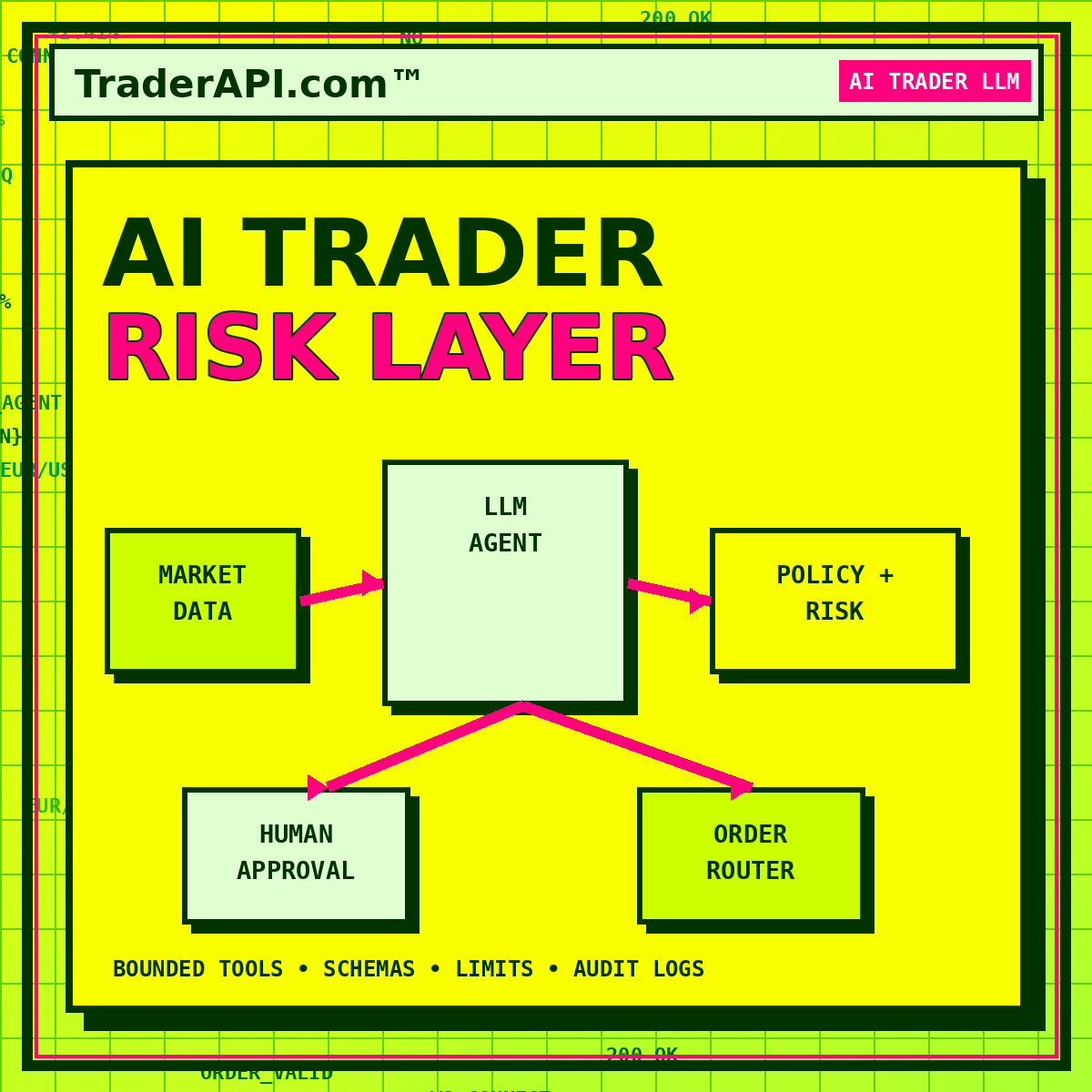
An Ai Trader LLM API is best understood as an orchestration layer. It can connect a model to trusted data and narrow tools, but deterministic services should own permissions, account limits, order validation, approvals, and execution. The language model interprets and communicates; policy code authorizes and constrains.
Do not choose an interface from a marketing checklist alone. Verify schemas, units, timestamps, permissions, failure behavior, testing conditions, and data-use terms for the exact product and account. A production integration should be able to recover authoritative state after a disconnect without guessing.
Capability map
Use these responsibilities to define architecture, acceptance tests, and provider evidence.
Time-stamped market data, documents, provenance, freshness, and source-aware summaries.
Typed functions for quotes, positions, analysis, proposals, checks, and approval requests.
Allowed instruments, order limits, exposure, restricted windows, and kill switches.
Immutable proposal details, risk results, expiry, authentication, and review evidence.
Restricted credentials, idempotency, reconciliation, state transitions, and errors.
Prompts, evidence, model version, tool calls, checks, approvals, orders, and monitoring.
Implementation
const adapter = {
  instruments: "provider identifiers",
  timestamps: "UTC + source context",
  numbers: "exact decimals",
  streaming: "snapshot + recovery",
  orders: "idempotent state machine",
  credentials: "server-side only",
  evidence: "docs + tests + logs"
};
Related research
A weighted evaluation framework for workflow fit, data, execution, security, recovery, and cost.
Read guide →Server-side credential patterns, least privilege, rotation, monitoring, and incident response.
Read guide →FAQ
It is an application layer that connects language models to trading-related data and controlled tools for research, explanation, proposals, approvals, or automation.
A safer architecture routes structured proposals through deterministic authorization, risk checks, and any required human approval before a restricted execution service acts.
Separate untrusted content from system instructions, restrict tools, validate every action, preserve provenance, and assume hostile text may reach the model.
Record relevant prompts, evidence, model and tool versions, structured outputs, policy results, approvals, provider requests, responses, and reconciliation events while protecting secrets.