Editorial note: This guide is educational and does not provide financial, legal, or investment advice. API features, access, and rules can change; verify current official documentation before implementation.
Start with the trading workflow, not the vendor list
A useful Trader API comparison begins with a specific workflow. “We need a trading API” is too broad to produce a defensible decision. A market-data dashboard, a paper-trading simulator, a discretionary order ticket, an automated strategy, and an AI-assisted research agent can all use APIs, yet each one imposes a different set of requirements.
Write the intended workflow as a sequence of actions. For example: discover instruments, request reference data, subscribe to quotes, calculate a signal, check account state, validate an order, submit it, monitor status, reconcile fills, and store an audit record. This sequence exposes the capabilities that matter and prevents an attractive feature list from replacing engineering analysis.
Separate requirements into three levels. A must-have is required for launch, such as the correct asset class or a sandbox. A should-have reduces operating effort, such as an official SDK or replayable event stream. A future option is useful but should not distort the first decision. This discipline also makes later platform reviews repeatable.
Separate market data from order execution
Many teams assume one provider must supply everything. In practice, market data and execution deserve independent evaluation. The best execution venue for an account may not provide the historical depth, normalization, licensing terms, or streaming ergonomics needed by the application. A modular architecture can use one source for research data and another for execution, provided symbol mapping and timestamps are handled carefully.
For market data, inspect the instrument universe, quote type, trade feed, order-book depth, bar construction, corporate actions, corrections, session rules, and historical availability. Ask whether timestamps represent exchange time, provider receipt time, or client delivery time. Determine whether bars are adjusted and how late corrections are communicated.
For execution, evaluate supported order types, time-in-force values, fractional quantities, account types, pre-trade validation, replace/cancel semantics, fill events, rejection messages, and post-trade reconciliation. “Supports trading” is not enough. The API must represent the exact lifecycle your system intends to automate.
Choose REST, WebSocket, and FIX by responsibility
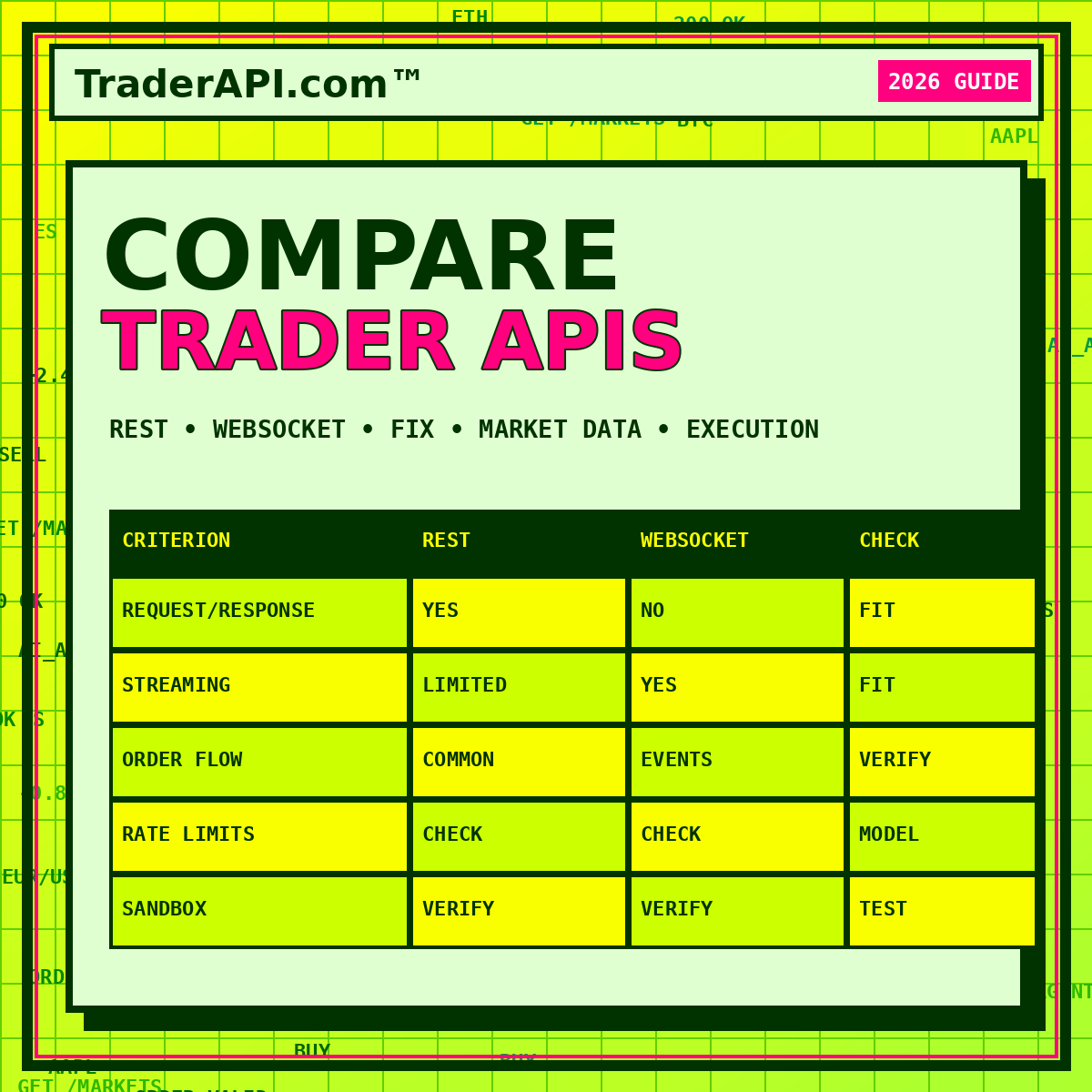
REST is usually well suited to request-and-response operations: instrument discovery, account snapshots, historical queries, order submission, and administrative tasks. Its strengths are visibility, straightforward tooling, and predictable error handling. It is less suitable for high-frequency state changes unless the provider offers a deliberate polling model.
WebSocket connections are commonly used for quotes, trades, order books, account events, and order-status updates. The comparison should go beyond the word “streaming.” Verify subscription limits, heartbeat behavior, sequence numbers, reconnection rules, replay support, backpressure handling, and the method for detecting gaps. A stream without a recovery strategy can silently produce incorrect state.
FIX may be relevant to professional execution workflows that need a standardized message model and institutional connectivity. It also introduces operational complexity, session management, certification, and a larger implementation surface. Select a protocol because it fits the responsibility, not because it appears more advanced.
Audit authentication and permission boundaries
Authentication design affects both security and day-to-day operations. Document how credentials are issued, where they can be used, whether signatures or nonces are required, how tokens expire, and how permissions are scoped. A key with read-only market data access carries a different risk than a credential that can transfer assets or submit orders.
Prefer platforms that let the team apply least privilege. Useful controls can include separate credentials by environment, account, strategy, or service; explicit read and trade permissions; IP restrictions; short-lived tokens; revocation; and auditable credential changes. Confirm whether the provider’s model works with server-side secret storage and automated rotation.
Never score an API highly simply because authentication is easy. A convenient credential that cannot be constrained may create unacceptable risk. Include incident response in the review: how quickly can a compromised key be disabled, and what evidence is available to investigate its use?
Evaluate reliability as a state-management problem
Uptime percentages are only one part of reliability. A trading application must know whether its local view of the market, orders, and positions is complete. Compare how the API communicates maintenance, throttling, degraded service, delayed data, duplicate events, and partial failures. Look for deterministic identifiers, idempotency support, sequence information, and endpoints that can rebuild state after a disconnect.
Design a failure matrix before choosing a provider. What happens when the quote stream drops but order submission remains available? What happens when an order request times out and the client cannot tell whether the venue accepted it? What happens when a fill arrives twice? The API should provide enough information for the application to recover without guessing.
A strong proof of concept intentionally triggers reconnects, rate limits, invalid orders, stale sessions, and service restarts. Happy-path demos reveal syntax. Failure tests reveal whether the integration can operate safely.
Treat sandbox quality as a production feature
A paper or sandbox environment shortens development, but only when its behavior is clearly defined. Compare instrument coverage, data realism, order types, session schedules, fill simulation, account resets, and differences from production. Some sandboxes are ideal for authentication and schema testing but unsuitable for strategy performance claims.
Create contract tests around the API boundary. Store sanitized example responses, validate schemas, and test how the client handles missing fields or new enum values. Use a replay harness for streaming messages. Build a shadow mode in which the strategy generates decisions but cannot send a live order. These controls reduce the chance that a small provider change becomes a production incident.
Paper trading is not a substitute for controlled live testing. Simulated fills may omit queue position, market impact, routing behavior, and real rejection conditions. Use it to validate software mechanics, not to promise future returns.
Calculate total operating cost and data rights
Headline API pricing rarely captures total cost. Include account requirements, exchange subscriptions, historical-data charges, per-request fees, streaming tiers, concurrency limits, professional data classifications, redistribution rights, and engineering labor. A lower monthly fee can be more expensive if the team must build extensive normalization or recovery infrastructure.
Data licensing deserves explicit review. Displaying data to an end user, storing it, deriving analytics from it, and redistributing it may be governed by different terms. The technical ability to retrieve a field does not automatically grant the right to republish it. Record the intended use and obtain appropriate legal review.
Model cost under realistic peak traffic, not an average day. Include reconnect storms, backfills after downtime, additional test environments, and growth in instruments or users.
Build a weighted Trader API scorecard
Convert the findings into a weighted scorecard. Suggested categories include market fit, data completeness, execution lifecycle, protocol quality, security, reliability, testing, documentation, support, licensing, and cost. Weight each category according to the workflow. A research terminal may prioritize historical data and redistribution rights; an order-management service may prioritize deterministic execution state and recovery.
Require evidence for every score. Evidence can be a documentation reference, a sandbox test, a support response, a contract clause, or an observed behavior. Mark unknown items as unknown rather than awarding a neutral score. Unknowns in trading infrastructure are risks to investigate.
The strongest Trader API choice is not the platform with the longest feature list. It is the platform whose verified behavior matches the system’s responsibilities and failure controls.
Revisit the scorecard periodically. APIs, access policies, products, and business needs change. A decision log makes future migrations and reviews much easier.
Use the Trader API directory, review our API review methodology, or contact the editorial team at [email protected].