Market discovery
Assets, pairs, product status, quote currencies, increments, minimums, and filters.
Developer research for cryptocurrency exchange APIs, with emphasis on numeric precision, streaming state, credential security, and regional access.
Developer overview
Crypto APIs can cover public market data, authenticated accounts, spot or derivative products, transfers, and order execution. Product names, legal entities, and regional availability can change. The first implementation task is to identify the exact product, account, and permissions—not to copy an example request from a different interface.
Do not choose an interface from a marketing checklist alone. Verify schemas, units, timestamps, permissions, failure behavior, testing conditions, and data-use terms for the exact product and account. A production integration should be able to recover authoritative state after a disconnect without guessing.
Capability map
Use these responsibilities to define architecture, acceptance tests, and provider evidence.
Assets, pairs, product status, quote currencies, increments, minimums, and filters.
Snapshots, incremental updates, sequence handling, spread, and depth aggregation.
Public trades, timestamps, identifiers, corrections, and reconnect behavior.
Balances, holds, open orders, fills, fees, and account permissions.
Valid price and quantity steps, order types, client IDs, and rejection handling.
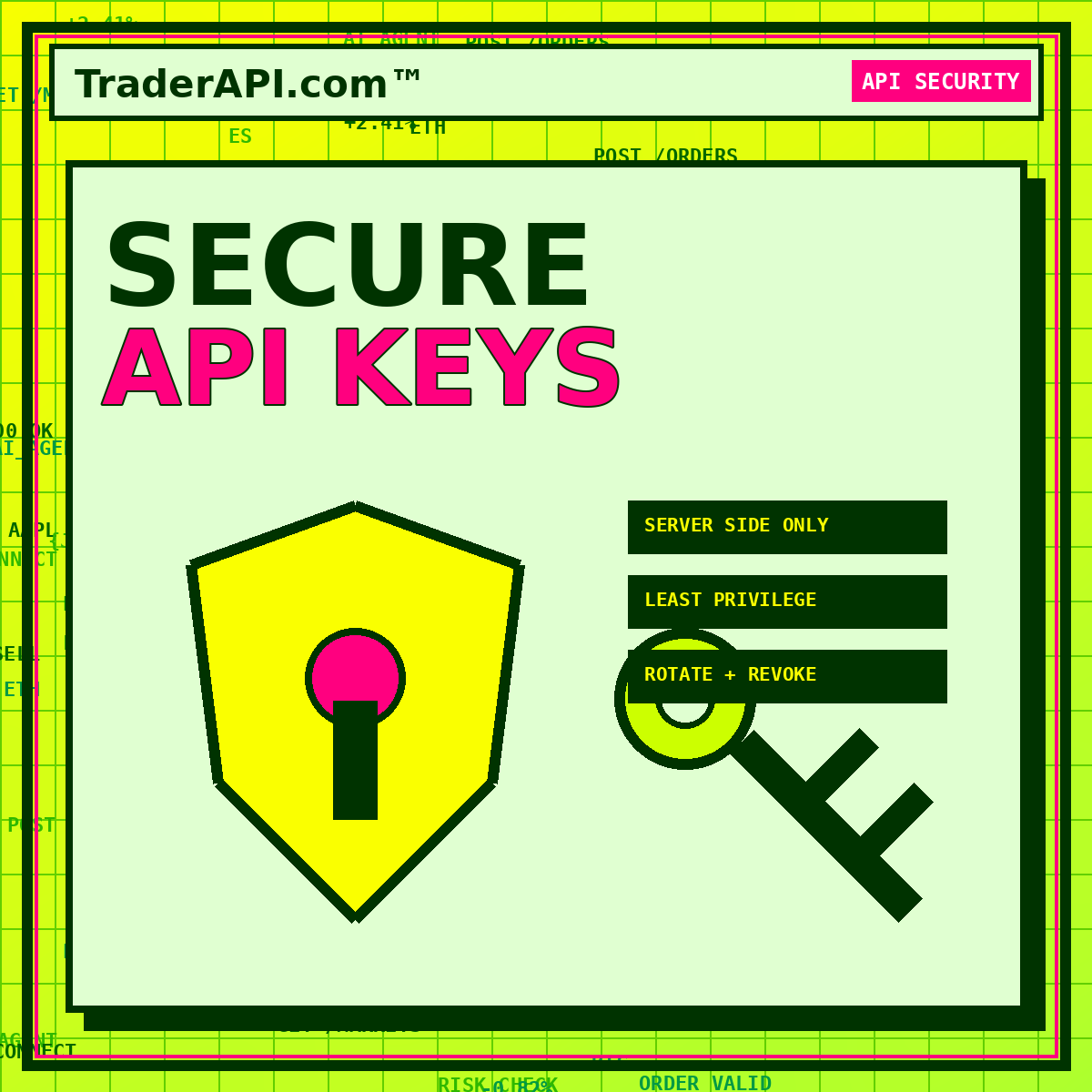
Server-side keys, signing, clock synchronization, least privilege, rotation, and monitoring.
Implementation
const adapter = {
  instruments: "provider identifiers",
  timestamps: "UTC + source context",
  numbers: "exact decimals",
  streaming: "snapshot + recovery",
  orders: "idempotent state machine",
  credentials: "server-side only",
  evidence: "docs + tests + logs"
};
Related research
Independent review questions for product access, filters, streams, orders, signing, and recovery.
Open overview →Developer research for products, market data, account state, orders, permissions, and monitoring.
Open overview →FAQ
It is an interface for cryptocurrency products that may expose public market data, authenticated accounts, order management, or other exchange services.
Exchanges can define valid price ticks, quantity steps, minimum values, and product status. Orders must be validated against current reference data.
A robust client follows the provider’s snapshot and incremental-update sequence, detects gaps, and rebuilds state when completeness is uncertain.
That depends on the platform. Prefer separate or narrowly scoped credentials and disable any permission the service does not need.