Editorial note: This guide is educational and does not provide financial, legal, or investment advice. API features, access, and rules can change; verify current official documentation before implementation.
Define the model’s role before connecting tools
An AI Trader LLM API should begin with a narrow statement of responsibility. A language model can summarize research, extract facts, classify events, explain portfolio changes, draft a trade thesis, or propose a structured action. Those tasks do not require unrestricted authority over a brokerage account.
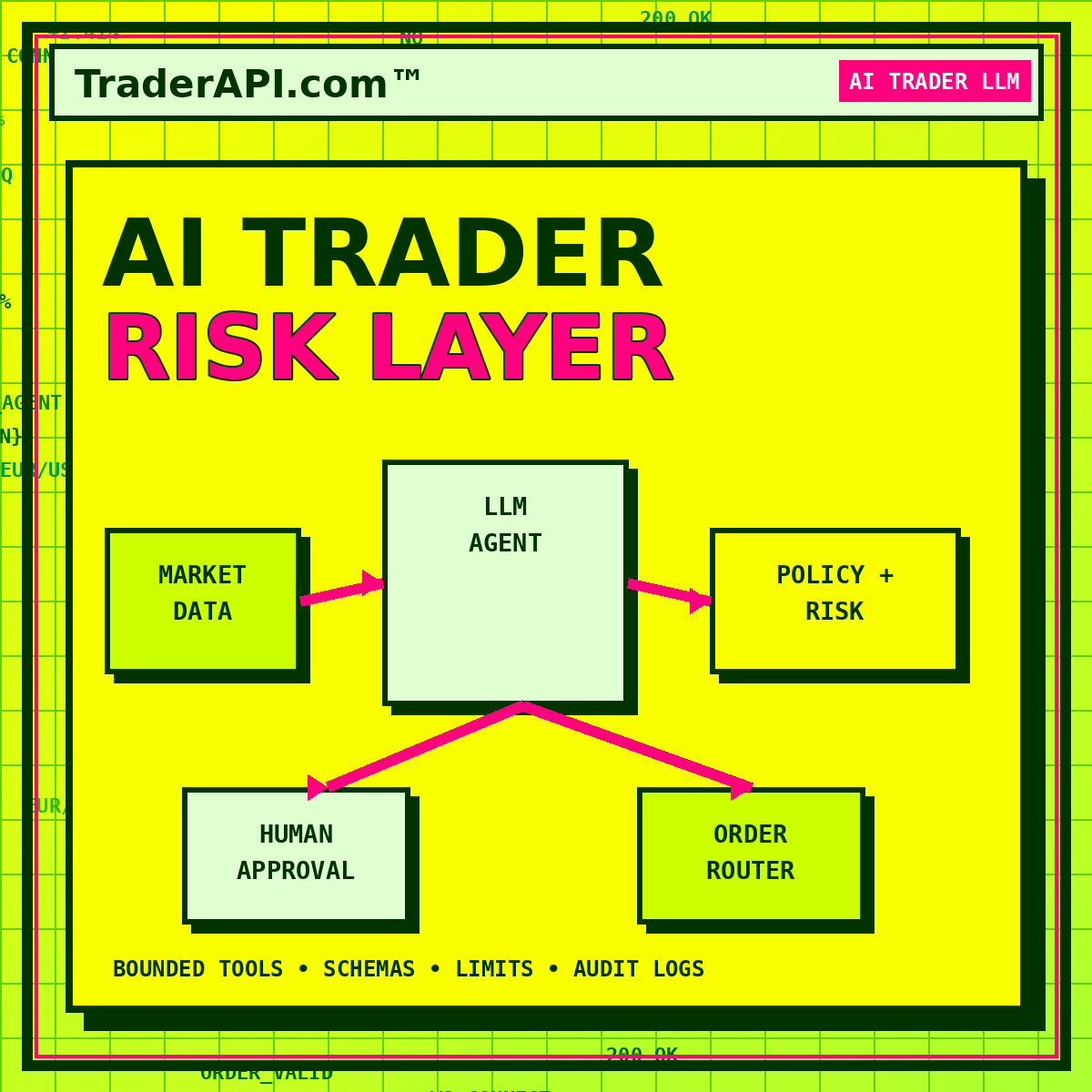
Separate analysis, recommendation, approval, and execution into distinct stages. The model can contribute to analysis and recommendation. Deterministic services should enforce account permissions, position limits, instrument eligibility, market hours, order constraints, and approval requirements. The execution service should accept only validated, typed commands.
This separation prevents natural-language ambiguity from becoming an order. It also lets the organization change models without rewriting its core risk system. Treat the model as one input to a controlled workflow, not as the control plane.
Expose bounded tools instead of raw endpoints
Giving a model a generic HTTP client or a complete brokerage credential creates an unnecessarily large action space. Provide a small catalog of tools with explicit schemas. Examples include get_quote, get_positions, draft_order, run_pretrade_checks, and request_human_approval.
Each tool should validate types, enumerations, quantity ranges, symbols, and account context. It should return structured errors that the orchestration layer can handle. A draft-order tool should produce a proposal object, not submit an order. The proposal can include the model’s rationale, source references, confidence language, expiry time, and requested action.
Tool permissions should be assigned by use case. A research assistant may access public market data but no account information. A portfolio assistant may read positions but not trade. A supervised execution assistant may create proposals that expire unless a human approves them.
Create a trusted data boundary
Trading decisions can be influenced by untrusted text from news, filings, social posts, websites, or user uploads. That content may contain instructions designed to manipulate an agent. The architecture must distinguish data to analyze from instructions the agent is allowed to follow.
Normalize external content into a clearly labeled evidence layer. Preserve source, timestamp, instrument mapping, and retrieval context. Do not allow a document to change system policy, tool permissions, or approval thresholds. Use content filters and retrieval rules, but assume adversarial text can still reach the model.
Market data also needs provenance. Store provider timestamps, freshness, and quality flags. A model should not make a time-sensitive recommendation from stale or partial data without a visible warning. The risk layer should reject actions when required inputs are missing or outside freshness limits.
Put deterministic risk checks in front of execution
Risk checks should be code and configuration, not a prompt. Typical controls include maximum order notional, position size, daily loss limit, allowed instruments, allowed order types, price collars, duplicate-order prevention, restricted trading windows, account-level exposure, and a global kill switch.
Checks should run against current account state immediately before execution. A recommendation that was safe two minutes ago may be unsafe after another fill or a price move. The engine should return a machine-readable decision: approved, rejected, or approval required, along with rule identifiers and values.
Keep the model outside the final calculation. It may explain why a rule rejected a proposal, but it should not override the rule. Changes to limits should require an authenticated administrative workflow and should be logged separately from model activity.
Design human approval as a real control
A superficial “Are you sure?” dialog is not sufficient. The approval screen should show instrument, side, quantity, order type, limit or stop values, estimated notional, current position, resulting exposure, data freshness, risk-check results, and the model’s cited rationale. The approver should see what will be sent, not merely a conversational summary.
Approvals should be tied to an immutable proposal hash and expire quickly. Any material change—quantity, price, account, instrument, or order type—should invalidate the approval. Higher-risk actions can require two people or a second authentication factor.
Organizations that permit automated execution should still use graduated authority. Start with research-only mode, then shadow mode, paper trading, tiny notional limits, narrow instruments, and continuous review. Automation is a control decision, not a model setting.
Make order routing idempotent and observable
The execution service needs a stable client-order identifier and an idempotency strategy. If a network request times out, retrying blindly can duplicate an order. The router should reconcile by identifier, query authoritative order state, and record every transition from proposal through acknowledgment, fill, cancellation, or rejection.
Use an event log for model prompts, retrieved evidence, tool calls, risk results, approvals, outbound requests, provider responses, and reconciliation. Sensitive values should be protected, but the record must be detailed enough to reconstruct why an action occurred.
Monitoring should detect unusual tool-call frequency, repeated rejected proposals, stale data, position drift, stream gaps, approval bypass attempts, and divergence between internal and brokerage state. A kill switch should stop new actions without preventing the system from reading and reconciling existing positions.
Evaluate behavior with scenarios, not a single accuracy score
Language-model evaluation for trading workflows should test scenarios. Include ambiguous symbols, stale quotes, conflicting sources, malformed tool responses, prompt-injection attempts, closed markets, insufficient buying power, duplicate events, sudden volatility, and unavailable providers. Measure whether the system refuses, escalates, or recovers correctly.
Track proposal validity, citation quality, unsupported claims, tool selection, schema errors, risk-rule violations, approval outcomes, and operational incidents. Financial return is not an adequate model-quality metric because it mixes market randomness, strategy design, execution, and risk.
Run regression tests whenever prompts, models, tools, rules, or data providers change. Version all components so an audit can identify the exact configuration behind a decision.
A practical reference architecture
A defensible AI Trader LLM API can be organized into seven services: a data gateway, retrieval and provenance layer, model orchestrator, bounded tool gateway, deterministic policy and risk engine, approval service, and idempotent execution router. An audit and monitoring plane observes every service.
The model never receives a raw trading credential. The tool gateway authenticates the orchestrator, the risk engine validates proposals, and the router owns the restricted brokerage credential. This structure limits blast radius and makes responsibilities testable.
Use the language model to interpret and communicate. Use deterministic systems to authorize, constrain, and execute.
No architecture eliminates trading risk. The goal is to prevent avoidable software and governance failures while making decisions inspectable.
Use the Trader API directory, review our API review methodology, or contact the editorial team at [email protected].